Thursday, March 1, 2012

Don’t Do It—For A Better Tomorrow

I’m not entirely sure what I was getting at with the last post, but I think I was prodding at the idea of renunciation as rebellion. On the one hand, it seems like boycott is the lazy man’s path to social change. (What could be easier than doing nothing?) On the other, it sure seems like there’s a lot of evil we could undo by just not participating.

Don’t buy those blood diamonds, for instance.

Don’t buy tickets to the Hollywood movies that fund the MPAA’s war on the Internet.

Don’t drive (and don’t buy gas) if there’s any other conceivable way of getting where you need to go.

Don’t use credit cards for routine purchases. Why support the banks with more transaction fees than you have to?

Don’t buy expensive gifts on Christmas—focus on making things for the people you love, instead.

Don’t click on those banner ads. If nobody did it, they would go away.

Don’t say yes to aggressive sales pitches—ever. If they were rendered completely ineffective, you wouldn’t have to listen to them any more, and the poor employees of faceless corporations wouldn’t be required to put their voices behind things they don’t believe in to keep their jobs. Corporations could go back to producing items of genuine value that people legitimately want to buy.

Don’t purchase the extended warranty or the protection plan. Ever. They exist to make money, not to protect you, and they just give the company an excuse to shovel more obsolescing  shit into your hands, ticking to a break-down just past the expiration of your contract.

Don’t pay for that insurance policy. It’s powering a system that exists to take in more money than it pays out, while driving the cost of services out of reach of the people who need them most. Health insurance, auto insurance, home insurance—isn’t it interesting that we’re legally required to pay these? If they had real value, would we be required to buy them at the point of a gun? Free market, my foot!

For god’s sake, don’t take that loan! Why would you pay interest on crap you you didn’t need in the first place?

And for the love of God don’t go into debt for that college education—which, thanks to the ubiquity of student lending, costs more than a house, without providing a single square inch of shelter.

Even if you have the money, think twice and then twice and then eight times more before you say yes to that college education. It’s an ultimately meaningless piece of paper in a world where everyone has one. Wouldn’t you be better off using those four to eight years building up work experience and saving for a house?

Start saying “no” to bullshit and you discover there’s very little left in our daily experience to say yes to.

Ah, but think of what we can do then, as we start seeking out real relationships and experiences to treasure.

Wednesday, February 29, 2012

Fountain Pens, Retro-Tech, and Rebellion

Fountain1

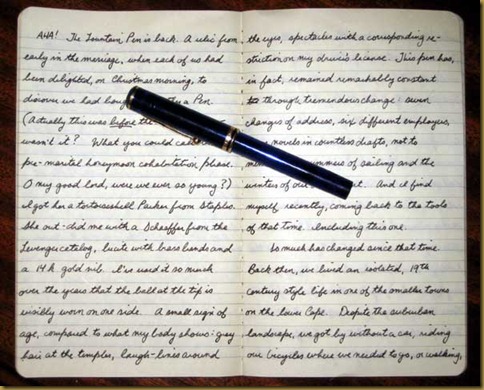
AHA! I’ve broken out The Fountain Pen again! It’s a relic from early in The Marriage, from a year when each of us was delighted, on Christmas Morning, to discover we had bought the other a pen. We were each going to be writers, you see.

Actually, come to think of it, this was before  the marriage—what you could call the pre-marital honeymoon and cohabitation phase.

My Good Lord, were we ever so young?

I bought her a tortoiseshell Parker from Staples. She out-did me with a Schaeffer from the Levenger catalog, a semi-translucent Lucite barrel with brass bands and a 14k gold nib. I’ve used it so much over the years that the tip is visibly worn on one side. This is a small sign of age, compared to what my body shows: grey hair at the temples, laugh-lines around the eyes, spectacles on the face with a corresponding restriction on my driver’s license. This pen has, in fact, remained constant through tremendous change: seven different addresses, six different employers, three novels in countless drafts, summers of sailing and winters on skis.

Now I find myself coming back to the tools of that time. Including this one.

While so much else has changed. Back then, we lived an isolated, 19th century style life in one of the smaller towns on the lower Cape. In a rebellion against the suburban landscape, we survived without a car, riding our bicycles where we needed to go, or walking if there was snow on the sidewalks. There was no Internet, not in the town where we lived, not at a price we could afford. What there were, were plenty of A.O.L. floppy discs coming through the mail, handy to re-format and use as backups for the WordPerfect documents I wrote on The Wife’s laptop, a machine that had cost her $3000 several years earlier, in college. (For several decades there, it seemed that a new computer always cost $3000.) This laptop was a revelation to me, as was the bubblejet printer that could output any font in any size—bringing home to me for the first time the full significance of the Kitchen Table Publishing Revolution. And then for some reason I never entirely embraced it. I wasn’t ready to abandon my Olympia and Remington desktop typewriters. (Later on I did abandon them, to my even later regret.)

We lived our lives in a sort of bubble, getting our news from newspapers purchased at the Superette a couple of miles away, or from the magazines we picked up at the Post Office just down the street from the Superette. Serious entertainment would come from the books we bought in binges from second hand shops in Provincetown or Wellfleet, when friends were kind enough to take us there in cars—or lend their cars to us. (Have you ever wondered if people read Shakespeare for fun? That used to be us, sitting by the fire, arguing over who got to be King Lear and who had to take on all three daughters.) Lighter entertainment came through the TV we had, which was one of those wood-encased models on wheels (the wood would later catch fire) coupled to a VCR. If we walked for two miles in the opposite direction of the Superette, we could reach the Video Empire, which, despite the grand scale implied by its name, was actually a tiny little rental shop in a four-store strip mall. This is where we encountered the BBC renditions of Sherlock Holmes with Jeremy Brett, and considered ourselves cultured. But on the nights when we didn’t have the energy to pedal to the rental place, we could always pick up one snowy channel whose signal somehow made its way across Cape Cod Bay from Boston. This is how we discovered Judge Judy, as well as a particularly egregious TV adaptation of Conan the Barbarian. Pickings were slim. So other nights we just watched our bootleg recording of Young Frankenstein, which eventually caught fire.

But now look at us. We live in a small house in an isolated Cape Cod town. Well, that hasn’t really hasn’t changed. We have a car, too. But we drive it as little as possible thanks to the tremendous cost of gasoline and repair. So transportation hasn’t changed much either. Instead of the 1890s, we embrace the values of the 1930s. It’s a big step, even if we’re still completely out of our time.

But we’re connected. There are six computers in the house, and a few of them were manufactured just last decade. More importantly, we’ve got a router, and a broadband connection—and this changes life entirely. Now, we can purchase goods from around the world and have them delivered a couple days later. We can watch movies and television programs on demand. The answer to any question we have comes to us through our “Glowing Mother”, The Wife’s nickname for Google piped on to an LCD.  We can follow political revolutions as they unfold, absorbing photos, videos, and reports delivered by citizen journalists and activists around the planet. We can know it all. And if anyone was listening, we could tell it all.

Yet I’m sitting here scratching away with a fountain pen, just as I was all those years ago. Is this the sign of some mental defect? An unwillingness to adapt? Or worse, could this be a sign of intransigence, resistance, incipient luddite revolutionism?

There was a banner in my High School gym that exhorted, “Lead, Follow, or Get Out Of The Way.” Whenever I saw this, I was happy to step to the sidelines, ignore the game, and hang out in my own little mental workshop. Don’t mind me, I’ll just be over here, not playing dodge ball. And I was always proud of this rejection. I could rebel by doing nothing. I was your modern day Thoreau.

But today—isn’t this what everyone is doing, with their tablets and their smart-phones? Today, isn’t it the crowd that’s tuning out the big game and plugging in to some kind of interior monologue?

Granted, they’re not alone. They’re texting, reading watching—communicating. But they’re taking themselves out of the local struggle and plugging into an echo-chamber of increasingly-fine-selected special interests. They’re skimming personal-tailored newsfeeds to reinforce their preconceptions and world views, just the way Dick Cheney insisted on having the TV in his hotel room pre-tuned to his precious Fox News. They are alone without being alone. They ignore the game and rebel, but they’re paying subscription fees to participate in the revolution.

I suppose this is what the free market is meant for. Every decision about where to spend our time and money is a sort of revolution, a rejection of what we’d supported before. A bigger market means more options, more chances for satisfaction. This keeps the money flowing, since a system with more options makes it more difficult for people to withdraw from the system entirely. The free market means you can disagree and still be welcome. So long as you spend money, you’re still one of us.

Even pirated music has to come across subscriber-supported lines. Even the pirate’s modem is plugged into electric utilities.

Even this fountain pen, with its gold nib—mined, no doubt, in some miserable hole by long-suffering hands—the use of such an object is a participation in a system, and represents my membership on the team of consumers. Come to think of it, I am on my last ink cartridge, and must soon head to the corporate store, or click Buy Now on the corporate website to acquire more. I’m not opting out. I’m paying in with everybody else.

But no. With this pen, there is some rebellion. It’s in the longevity. This pen has put down half a million words by now. It’s crossed out just as many. It was purchased once, as a token of love, and used hard for a decade and a half. I may have bought cartridge upon cartridge, but I’ve bought no other fountain pen in 15 years. And there’s a rebellion in this monogamy which just turns me on, somehow.

Fountain2

Saturday, February 25, 2012

ITAM Excuses Just In Time

Is it the end of International Typewriter Appreciation month already? Did I miss it?

No? I still have time?  Thank goodness.  Better bust out the old stable of tools…

IMG_4292

ITAM01

ITAM02

ITAM03

You’ll pardon the lack of a scanner, I hope. These pages were all photographed with natural light, under a skylight. A little crude, but I rather like the gradients of light washing across them. And if I wanted perfection, I wouldn’t have bothered with the typewriters at all.

The final draft was from the Royal Safari. I did a rough copy on my Lettera 32.  Remember the days of editing by hand? I still find that this is the best way for me to polish my thoughts, and in many cases I discover I actually had more to say than I thought the first time through. My rule of thumb has always been that if I cut more than I add with each revision, it’s all right.

I’m not sure I got the balance right on this one.

ITAM_Revision

(Kind of reminds me why they invented double-spacing.)

The Lettera 32 is a nimble little machine for rough drafts and getting the ideas out. It doesn’t weigh much more than the IBM keyboard.  And I’ve actually got room for it on my desk with all the other junk.  I’ve just never been entirely satisfied with the output. The type always comes out light and grainy, even with a fresh ribbon.

The Royal Safari is a bit slower. Type too fast, and the letters start to bunch up. But the typeface is just right, somewhere between pica and elite, just ornate enough and just classical enough. So if you can get into the right rhythm with it, it’ll give you a sharp final copy.

He’s the obligatory shot of my treasured M-Series.

ITAM_Keyboard

Is that grime or patina on the corners and between the keys? Doesn’t matter—it’s history.

Speaking of history, here’s the old Mercedes we had, back in the day.

Mercedes

Probably the finest car we ever owned, or ever will own. It may have gotten 14 miles to the gallon, but boy, were those ever stylish miles. $2000 for a new timing chain was where we drew the line. Sold it to an eager enthusiast for what we’d paid for it years before.

She’s still running, though. I saw her in a local parking lot, with the same obsolete security sticker on the back of the rear-view mirror. I’m glad she’s in good hands.

Good machines, you take care of them, they stick around.

Friday, February 3, 2012

Branding and Distraction

The age of distraction is getting even more distracting. Just turning on a computer now means exposing yourself to notices and branding as soon as the electrons start to flow.

I get the Macintosh chime when I turn on my Apple. Then the anti-virus program pops up a window to tell me about how many threats it's protected me from. Clicking this leads to a web-site that tells me it's monitored 503 "suspicious processes". I guess I'm glad somebody's monitoring them. Launching Evernote--my preferred word processing and research utility--exposes me to little nagging ads in the bottom corner which I can only eliminate by giving them money. (And I would gladly pay them money if it meant a one time purchase. But Evernote wants us to subscribe, and I'm just not ready to pay a subscription fee for access to my own writing.) Then when I launch Firefox, the Google home page comes up with a notice that they want me to "Like" them on Facebook.

Good grief. I haven't read or written a single word yet, and my head is already spinning.

Is it any wonder we all have attention deficit disorder? (For the record, I don't. Or at least I'm not medicating myself for it.)

The question is, how much do I want to cut myself off from these distractions? In a very real sense, we go to our computers to be distracted, the same way we used to go to our televisions. (What's that? People still use televisions? I guess so. Just the other day I was floored by a co-worker who told me she didn't like football, but she always watched the Super Bowl for the commercials.) We want the unexpected. We want something marvelous and new to "pop up" and give us a little rush of endorphins, to make us want to click something. Maybe even want to want something.

Only the objects of desire we're presented with are so banal. The chance to "like" Google on Facebook? I don't think we have the choice of liking Google or not, since they're changing their privacy policy and our online lives simply are Google, at this point. Online security reports? I suppose I should be thrilled I can use this computer I paid a big chunk of salary for without having my bank accounts raped by phishers and malware. But it used to go without saying that you could use the tools you purchased, without them chiming in to tell you what a good job they were doing every hour.

It's the banal stuff getting pushed at us that's crowding out the interesting stuff we come here for. The dark forces that drive television are threatening to turn the Internet into something bland, something that encourages passivity rather than curiosity, and something that you have to spend more and more money, every day, to enjoy.

How do you keep your focus, on the Internet? How do you walk the line between being distracted by crap and finding the stuff you came here for?

Wednesday, January 18, 2012

Trying to Contact My Senator

Hmm, this is interesting.

I was going to send senator Kerry a quick email to let him know how I feel about the SOPA and PIPA legislation worming its way through congress. (Quick synopsis: I don't like it.)

Except when I click on his "contact me" link I get a 404 We're Sorry page.

Which is the same thing I get when I click on any link of his website.

So either he's joined the day of protest along with Google, Reddit, Wikipedia, and hundreds of others, or his servers are down, or he just doesn't want to hear what we have to say.

Either way, I don't like it.

If you're not familiar with this legislation, and you're at all fond of the internet (and if the idea of spending 5 years in prison for singing "Happy Birthday" on youtube seems unreasonable to you) I urge you to get educated quick and register your displeasure to your representatives. Google has a handy page set up for this.

Also, check out the livestream of the SOPA and PIPA protests, if you're on today.

Interesting times.

Thursday, November 24, 2011

Things to be Thankful For

  • An old car with the good manners to break down within coasting distance of my own driveway, on the night before a day off.
  • A mother out of state for the winter who is willing to lend me hers.
  • A sister coming to Thanksgiving dinner to drive me from the broken down car to the running car.

Seriously, as far as inconveniences go, this one was coordinated like a ballet.

Then there’s all the other usual stuff we take for granted: a roof over our heads (that only leaks when it rains really hard), a job where I get to work with lots of kind and genuine people, food for  the table, a wife who is not only willing but happy to cook it, family to share it with, good health, and of course, also, eggnog.

And whiskey.

I work with a woman who’s mother used to punish her, when she complained too much, by sending her into the corner to count her blessings. I do tend to grumble a lot. (That’s why you’re all here, isn’t it?) But this seems like as good a day as any to take her mother’s advice and reflect on the stuff that’s going right.

So, I’ll be over here in the corner.

With my eggnog.

Monday, November 21, 2011

Reading The Hunger Games feels like Reading Tomorrow’s Newspaper

I started reading the first book in the Hunger Games series. And I can see why it's so popular with today's teen set. The book reads like a dark-hearted SF thriller, but it paints a frightening picture of the world our children are set to inherit. 

Here is a society built on the ruins of the one we live in now.  It's seen the return of scarcity. It's seen the divide between first and third world conditions move within the borders of our own country. It's seen martial law in the wake of collapse, with capital punishment for theft imprisonment for hunting and gathering your own food. It’s seen a new world order with poor outlying districts feeding into the wealth of one centralized, prosperous capitol. Meanwhile, for entertainment, the "reality show" is carried to it's logical conclusion: children are forced to fight to the death on television for the public amusement, with a supporting staff of stylists, producers, "game designers," and sponsors to make it all profitable. 

Granted, the Japanese got to the conceit of kids fighting to the death on a reality show first, with Battle Royale. But their take on it was campy and cartoonish, their explanation for why it was happening was felt like an attempt to make light of problems in their public schools. But Hunger Games is deadly earnest, building on chilling economic and environmental trends. We've sown conflict around the globe; it seems inevitable that it's going to swing back and hit us at home, sooner or later. 

This is the world our children see coming: constant war, rising food prices, ceaseless advertising, the cheapening of human life in pursuit of grander virtual and vicarious thrills, the abandonment of basic rights and dignity for the poor, while the rich extract human blood in the form of tribute paid in human offspring. 

You think this sounds hyperbolic? Try starting your adult life under the burden of a student loan you can never hope to repay, from which not even bankruptcy is an escape. Kids today are slaves from the minute they graduate college. (It's a funny twist of fate that today, it's the smartest kids who don't go to school.) Already, teens face an adulthood without dignity. It's not that far-fetched to see their lives as cheap enough to throw away in televised games.

Our kids are facing the collapse of the public safety net as it's raided by the disinterested greed of their boomer grandparents, while they struggle in the moral wasteland provided by the "it's all good" parenting of their Generation X and Y parents. Reality shows show them that success lies at the end of a path of opportunism, brutality, and luck, while advertisements bombard them with tawdry and unattainable examples of what that success would be. 

The result is that life is worthless unless you're at the top. So, why not gamble it all for a shot at the prize? (Bankruptcy might not be an option any more, but kids might fight to the death if the reward were forgiveness of their student loans.)

Science fiction used to give us tales of exploration, invention, colonization and prosperity. I'm not sure what happened in the last 30 years, but SF has become something that feels chilling and malicious, more akin to horror. 

It also feels a hell of a lot more real.